

Nearly every company building with AI right now is building some version of a RAG system.
That makes sense. Large language models are powerful reasoners, but they don't natively know your enterprise's internal knowledge , it's scattered across PDFs, databases, CRMs, knowledge bases, spreadsheets, emails, and internal tools. Retrieval-Augmented Generation (RAG) closes that gap by letting a model look things up instead of trying to memorize everything.
But here's the mistake I see constantly, including in my own early projects: teams treat RAG as one architecture. It isn't. There is no single "best RAG." There is only the right retrieval architecture for a given data topology, query pattern, accuracy bar, latency budget, and business problem.
Getting that decision right is often the difference between a genuinely useful AI system and an expensive, unreliable chatbot.
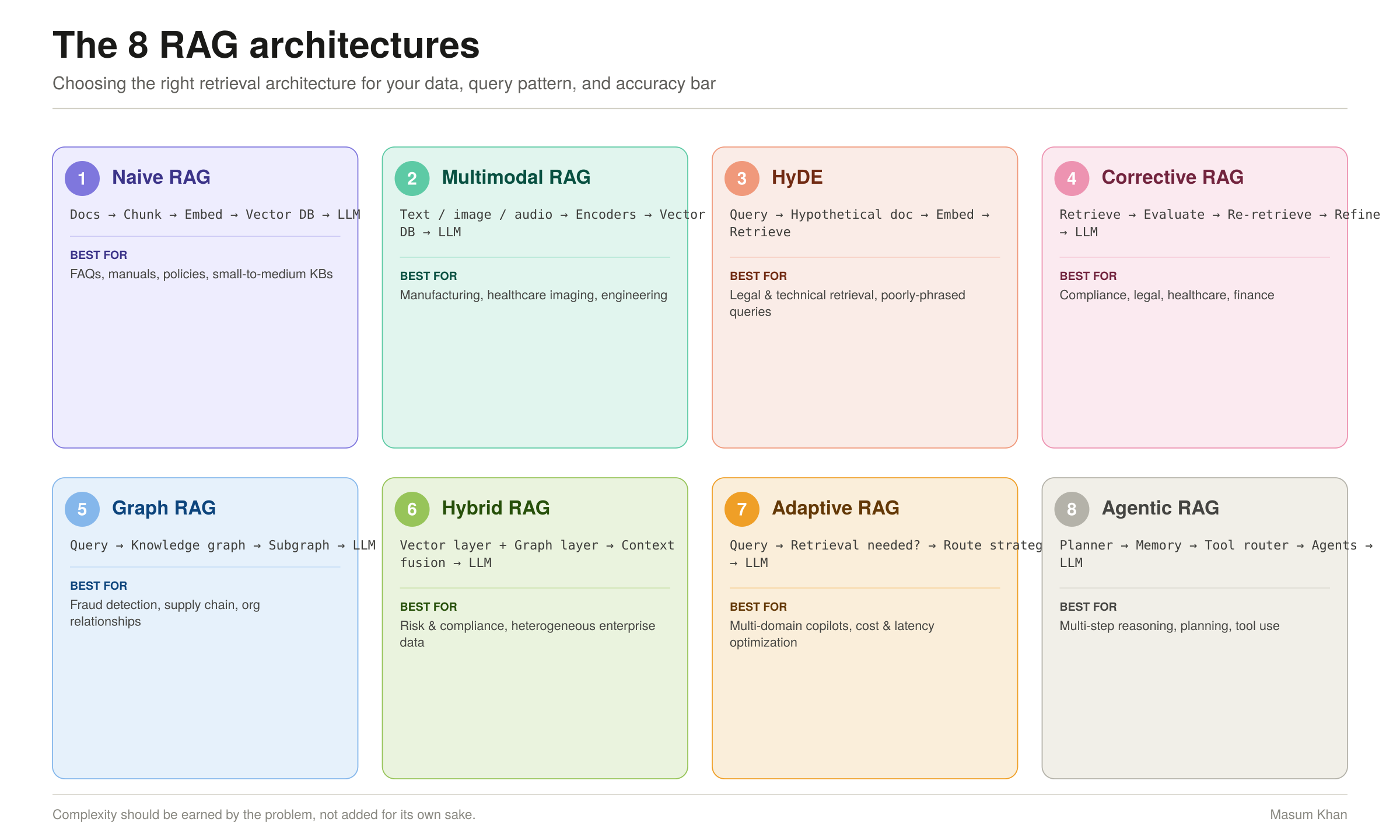
Below is a breakdown of the eight RAG architectures I think every AI builder should have in their toolkit , what each one solves, where it breaks down, and where I've actually seen it play out in real projects.
1. Naive RAG - the right place to start, the wrong place to stop
Pipeline: Documents → Chunking → Embeddings → Vector DB → Retrieval → Prompt → LLM
This is the pipeline most people mean when they say "RAG." It works well when your knowledge base is mostly unstructured text and the questions are direct lookups.
Good fit: "What is our annual leave policy?" → retrieve the relevant clause, hand it to the LLM.
Where it breaks: "Which employees are eligible for promotion based on performance, tenure, department policy, and current grade?" , now you need structured relationships across multiple sources, and naive vector similarity alone can't reason through that.
Best for: internal documentation, FAQs, product manuals, policy assistants, small-to-medium knowledge bases.
2. Multimodal RAG - when knowledge isn't just text
Real enterprise knowledge is rarely text-only. A manufacturing company's knowledge base might include maintenance manuals, CAD drawings, inspection photos, tables, and video. Text embeddings alone can't represent any of that meaningfully.
Multimodal RAG uses modality-specific encoders (text, vision, audio) so the system can retrieve and reason across formats.
Example: A technician photographs a damaged component and asks what's wrong. The pipeline retrieves visually similar cases → pulls the linked maintenance procedure → passes both to a vision-capable LLM.
Best for: healthcare imaging, manufacturing, engineering, financial charts, video intelligence, product support.
3. HyDE (Hypothetical Document Embeddings) - bridging the query-document gap
Sometimes the problem isn't retrieval quality , it's that the user's question doesn't look semantically similar to the document that actually answers it.
HyDE has the LLM first generate a hypothetical answer, embeds that, and retrieves against it , closing the vocabulary gap between question and source.
Example: "Can I terminate this contract without penalty?" vs. the actual clause: early termination is permitted subject to conditions in Section 14.2. Very little shared vocabulary , HyDE bridges that.
Best for: legal and technical retrieval, research systems, poorly-phrased or conversational user queries.
4. Corrective RAG - retrieval isn't automatically correct
A core assumption that quietly breaks a lot of RAG systems: retrieved ≠ relevant. Vector similarity can return something topically close but factually wrong or outdated.
Pipeline: Retrieve → Evaluate → Re-retrieve → Re-rank → Refine → Generate
Before passing evidence to the LLM, the system checks: Is this relevant? Sufficient? Trustworthy? If not, it retrieves again.
Example: A compliance assistant asked "Does this transaction violate our AML policy?" shouldn't just answer off the first three retrieved documents , it validates the evidence chain first.
Best for: compliance, legal, healthcare, financial services , anywhere a wrong answer is more expensive than a slower one.
(This is the exact principle I built into a Bangla/English legal-assistant RAG for the Bangladeshi legal corpus , with bilingual legal text, validating retrieved passages before generation isn't optional, it's the difference between a useful assistant and a liability.)
5. Graph RAG - when relationships matter more than similarity
Vector search answers "what's semantically similar to this question?" But many high-value enterprise questions are fundamentally relational:
"Which subsidiaries are exposed to suppliers affected by sanctions on Company X?"
That's not a similarity search , it's a traversal problem: Company → Subsidiary → Supplier → Country → Sanction → Regulation. A knowledge graph can walk that chain and construct a relevant subgraph instead of retrieving isolated chunks.
Best for: financial intelligence, fraud detection, supply-chain analysis, cybersecurity, complex organizational knowledge.
Rule of thumb: if your question contains owns, controls, depends on, is exposed to, is connected to , evaluate Graph RAG.
6. Hybrid RAG - often the practical enterprise answer
Why choose between semantic and relational retrieval when a context-fusion layer can combine both?
- Vector layer: relevant regulations, policies, contracts
- Graph layer: relationships between customers → accounts → transactions → entities → countries → regulations
Fused together before reaching the LLM, this is often much closer to how real enterprise knowledge actually behaves.
Best for: risk & compliance platforms, fraud detection, large organizations with heterogeneous data sources.
(This mirrors a GraphRAG roadmap I built for an FMCG client , a phased pipeline combining vector retrieval with graph-based relationship modeling for regulatory compliance, using Bangla/English-capable embeddings and a self-hosted vector store for data sovereignty. Hybrid isn't a "nice to have" once compliance and multilingual context both matter , it's the baseline.)
7. Adaptive RAG - don't retrieve when retrieval isn't necessary
Not every query deserves a trip through your entire knowledge base.
"What is 17 × 24?" doesn't need a vector search. Adaptive RAG first asks: does this actually require retrieval?
- No → Query → LLM → Answer
- Yes → route to the right retrieval strategy: vector, graph, lexical (BM25), hybrid, or a specialized index
This is closer to intelligent query routing than classic RAG.
Best for: general-purpose copilots, multi-domain assistants, cost and latency optimization at scale.
The real benefit isn't accuracy , it's avoiding unnecessary computation.
8. Agentic RAG - retrieval becomes part of reasoning
At the far end of the spectrum, retrieval stops being a single lookup step and becomes one capability among many that an agent orchestrates.
Architecture: User → Planner → Memory → Tool Router → Specialized Agents → External Systems → LLM
Example: "Analyze our Q2 performance, identify the three biggest risks, compare with last year, and recommend actions." That requires querying a database, retrieving reports, checking external market data, calculating metrics, and cross-validating evidence , this is an orchestration problem with retrieval as one tool among several, not "RAG" in the classic sense.
Best for: multi-step analytical copilots, financial and operational reasoning systems, workflows requiring planning and tool use.
Decision framework: matching architecture to problem
| Your Situation | Consider |
|---|---|
| Simple text documents | Naive RAG |
| Images, audio, video, charts | Multimodal RAG |
| Queries don't semantically match documents well | HyDE |
| Retrieval quality is inconsistent | Corrective RAG |
| Relationships between entities matter | Graph RAG |
| Both semantic and relational retrieval are required | Hybrid RAG |
| Queries vary significantly in complexity | Adaptive RAG |
| The system must plan, use tools, and execute multi-step tasks | Agentic RAG |
The mistake: jumping straight to Agentic RAG
I see this constantly , teams assemble agents, memory, tools, a knowledge graph, a vector DB, and multi-LLM orchestration before they've proven basic retrieval even works.
That's backwards. A more defensible evolution looks like:
Naive RAG → improve retrieval quality → Hybrid/Corrective RAG → Adaptive routing → Graph/Multimodal where justified → Agentic RAG only when the workflow genuinely requires reasoning and action
Complexity should be earned by the problem, not added because the architecture diagram looks impressive in a deck.
The uncomfortable truth: architecture rarely fails first , data engineering does
Most RAG failures I've seen (including lessons from my own builds) don't trace back to picking the "wrong" architecture. They trace back to:
- Poor document ingestion and chunking
- Weak or missing metadata
- Wrong embedding model for the language/domain (Bangla and English handled very differently, for example)
- No re-ranking step
- Context overload or duplicate information
- Stale knowledge with no refresh cycle
- No evaluation framework or hallucination measurement
- No access control or observability
A sophisticated Graph RAG on poor-quality data will lose to a well-engineered Naive RAG almost every time. Architecture doesn't compensate for bad information engineering.
Five questions I ask before choosing an architecture
- Data topology , unstructured, structured, relational, or multimodal?
- Query complexity , lookup, semantic search, multi-hop reasoning, or planning?
- Accuracy requirements , is a wrong answer annoying, expensive, or legally dangerous?
- Operational constraints , what matters most: latency, cost, scalability, freshness, privacy?
- Actionability , does the system just need to answer, or does it need to search → reason → decide → execute → verify?
That last question usually determines whether you're building RAG or moving toward an agentic system.
Where this is heading
The future isn't "RAG vs. Agentic AI." It's composable retrieval , an adaptive routing layer sitting in front of vector search, graph traversal, lexical search, multimodal retrieval, structured data, and external tools, with evidence validation and context fusion before anything reaches the LLM.
The most valuable skill for an AI architect isn't knowing how to stand up a vector database. It's knowing when not to use one.
Every company can connect an LLM to a vector store and call it AI. The differentiator is building systems that know what to retrieve, where to retrieve it from, how much to trust it, when to retrieve again , and when retrieval isn't the answer at all.
Which of these architectures are you running in production , and what pushed you toward it?